Biogon Play

Biogon

An idle colony of polygons that only climbs by being spent. Two triangles fuse into a square. The square earns less and reaches further. The rest is deciding when to trade.

iOS · Android · Web — no account, no sign-in

The fight

the active half

Your colony is the ammunition

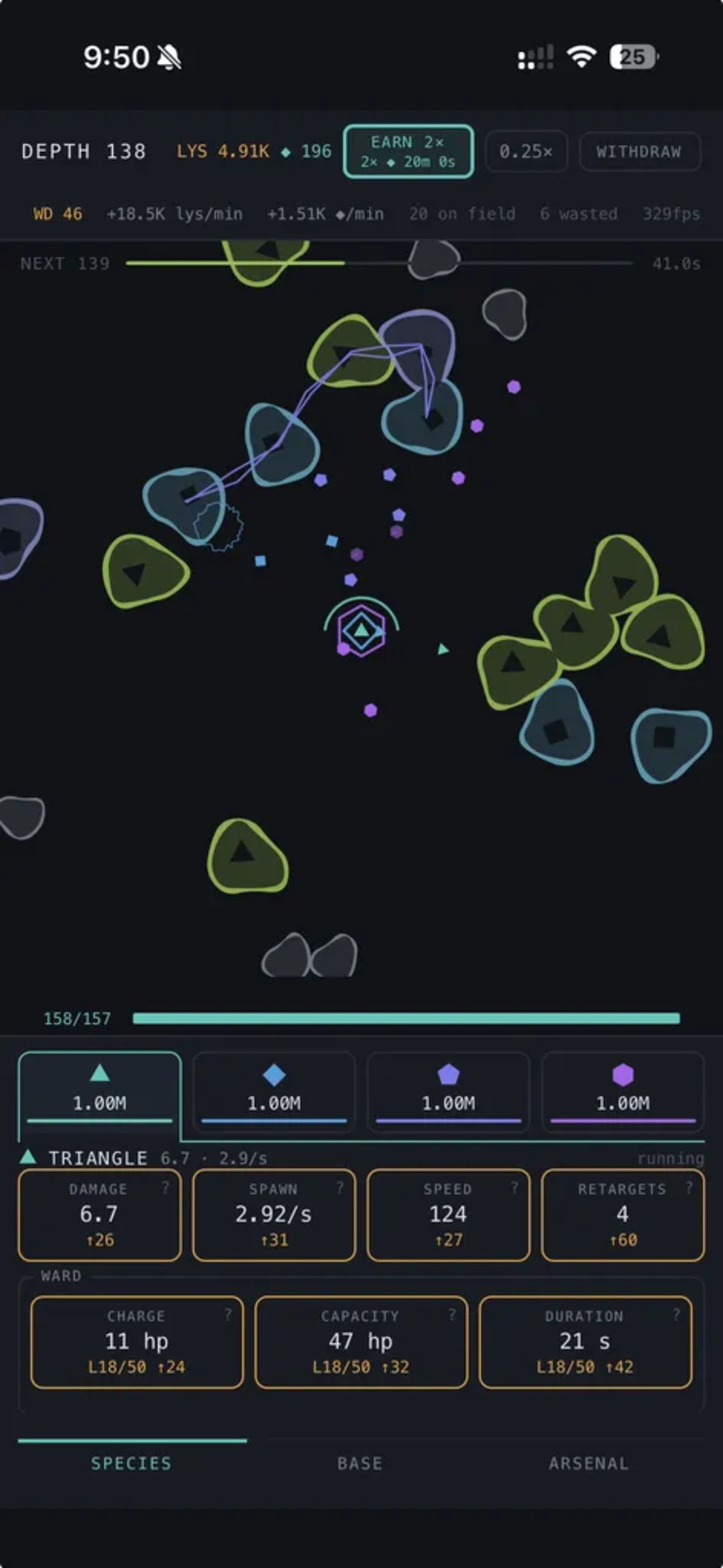
Contamination enters on an arc and converges on your base. Every shot fired is an organism that was standing in the colony a second ago and is now gone.

The fight can't be paused, and the colony keeps ticking on the other page of the same screen. Chambers draw continuously; cards fire only at a target. So when organisms run short, the fusion chain wins every draw and the fight starves — which is a decision, not a bug.

Go deeper and it pays more. Go too deep and you spend a colony that took four hours to grow, in ninety seconds, for nothing.

See it move

Idle and attended

It runs while you don't

Close it and the colony keeps going. Come back and the missed hours are replayed before the screen is drawn, so what you return to is a colony that lived rather than a number that was awarded.

Attention is worth something specific: organisms make waste, waste taxes income, and you can either clear it by hand for nearly nothing or install a scrubber that costs a slot a chamber wanted. Being there buys back a chamber. That is the whole of the deal, and it's the same deal at every scale.

  • Genre Idle · incremental, with a real-time defence on the other page
  • Platforms iOS · Android · browser
  • Price Free. Optional ads for a temporary boost; no paywall on progress
  • Sessions A run is ~4 hours of colony, checked in on. Or ten seconds, if that's the day you're having
  • Studio Moonlit Foundry
  • Status In production. Playable, unfinished, and changing weekly

The ladder

biomass ×0.80 · culture ×1.50 per rung

Fuse two, get one better

Triangles are cheap to make and don't do much. Fuse two of them into a square, two squares into a pentagon, and on up the ladder — every rung rarer than the one below it, and worth more.

The exchange is fixed and it never favours you. Two triangles earning 6.00/s come out as one square earning 4.80/s. What you get back is culture, which is what buys the ceilings your next colony starts against, and that goes up half again at every step.

So a run spends its whole length asking one question: keep growing, or start converting.

  • Octagon 31.46 /s
  • 2 Heptagon → 1 Octagon · −7.86/s biomass · +81 culture
  • Heptagon 19.66 /s
  • 2 Hexagon → 1 Heptagon · −4.92/s biomass · +27 culture
  • Hexagon 12.29 /s
  • 2 Pentagon → 1 Hexagon · −3.07/s biomass · +9 culture
  • Pentagon 7.68 /s
  • 2 Square → 1 Pentagon · −1.92/s biomass · +3 culture
  • Square 4.80 /s
  • 2 Triangle → 1 Square · −1.20/s biomass · +1 culture
  • Triangle 3.00 /s

Screens

in development
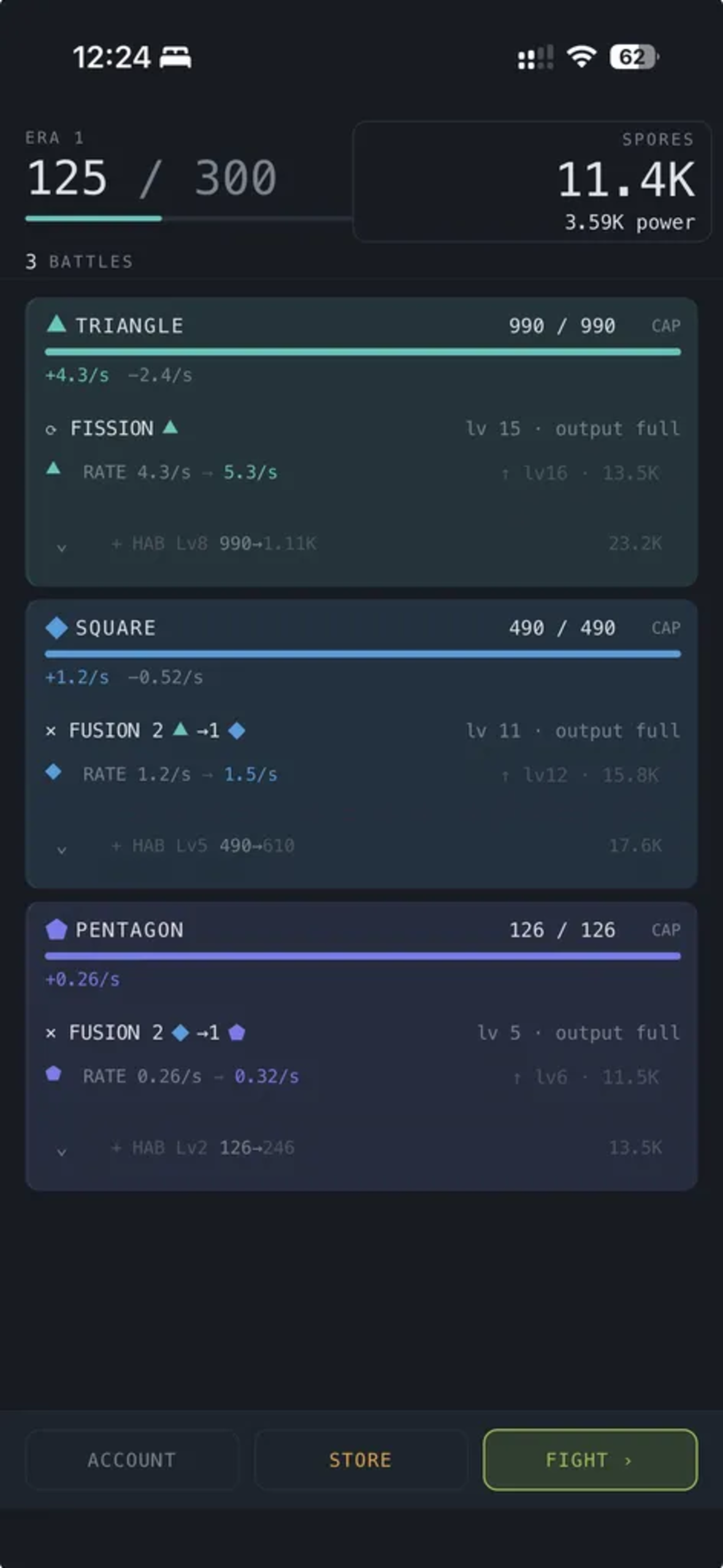
  • The colony screen: biomass and spore rates across the top, three chambers converting one species into another, and a triangle population pinned at its habitat cap.

    The colonyRates on top, chambers in the middle, the selected species and its one next purchase on the bottom.

  • The field at depth eight: green contamination masses drifting in toward a hexagonal base, with damage, spawn rate and speed controls beneath.

    The fieldContamination enters on an arc and converges. Nothing intercepts it but what the colony can spare.

  • A rate breakdown: spores per minute plotted over time, stacked by which species produced it, above the arithmetic that pays it out.

    Every number, openedTap a rate and it shows its own arithmetic — what makes it, and what that buys.

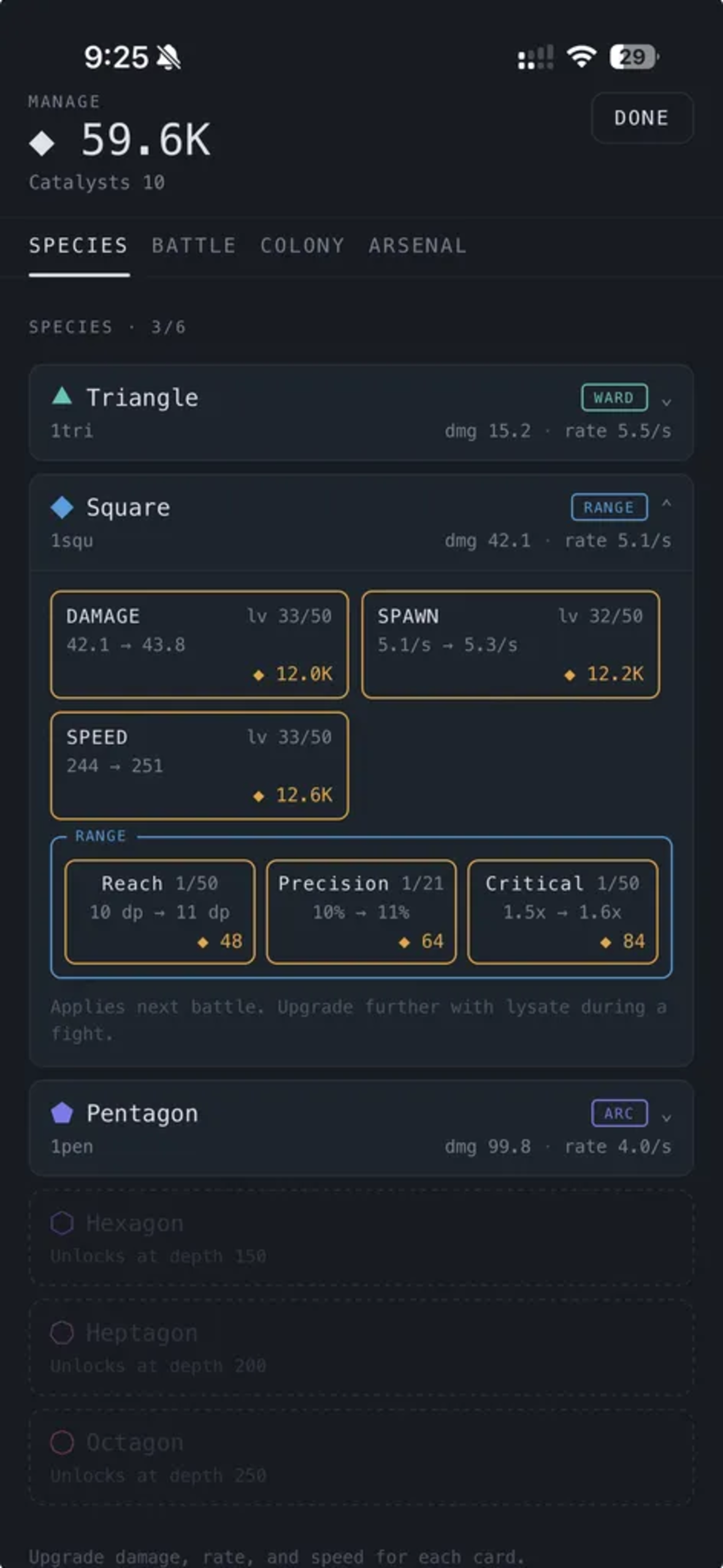
  • The run management screen: buildable chambers, open slots, the species ladder from triangle to octagon, and the development panel.

    Managing a runSlots, species and chambers — the small set of allocations that make a run a build.

Start with three triangles

No account, no install. It saves in the browser and picks up where you left it.

Play in browser